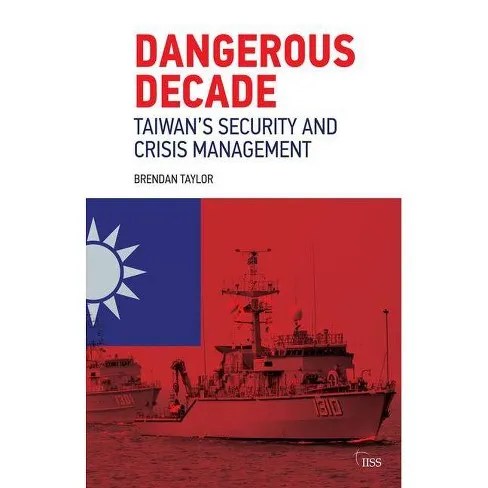
Brendon Taylor, Dangerous Decade: Taiwan’s Security and Crisis Management, (London: International Institute for Strategic Studies, 2019).
In August, Nancy Pelosi led a delegation from congress on a visit to Taiwan in a show of American support. China, in an expression of opposition, held military drills that appeared to simulate an invasion of the island among other military actions. Such actions showcase the political importance of Taiwan as a vibrant democratic nation in East Asia but also highlight the dangers associated with crafting policy for Taiwan; a simple miscalculation can spark a great power conflict between China and the United States with the potential to reshape the world system. Therefore, the United States and China require carefully crafted policies that can avoid sparking a crisis.
Brendon Taylor, in Dangerous Decade, argues that a narrow set of crisis management tools, in particular confidence building measures, are required to ensure that a larger conflict does not spawn from another Taiwan Straits crisis (p. 13). While confidence building measures are a viable policy option, a consistently shifting status-quo makes them difficult to craft and enforce. While Taylor adeptly analyzes the policy options for avoiding conflict across the Taiwan Straits, his book falls short in addressing the critical historical and political shifts that would impact such political decisions.
Taylor starts his argument by analyzing the delicate state of the status-quo. In short, Taylor analyzes the status-quo as the set of agreements that Beijing would not seek military action, Taipei would not pursue independence, and Washington seeks to deter the two (15). This situation creates a delicate balance of power that is held in place by the overarching threat of great power conflict. A critical aspect of the delicate balance of power is the potential for military conflict. For example, Chinese development of nuclear submarines and counter-space capabilities raise the incentives for American and Taiwanese development of military technology (84-86). Increasing incentives for military development can spark an arms race, increasing the potential for accidental escalations across the Taiwan Straits.
A simple miscalculation can spark a great power conflict between China and the United States with the potential to reshape the world system.
While Taylor’s analysis hits the high points of this delicate balance, there are a few key weaknesses in Taylor’s analysis. First, there is not quite enough analysis about the previous Taiwan Straits crisis and how those are currently impacting Chinese and American policy making. A deeper analysis may reveal some weaknesses in using confidence building measures since both sides seem firm on ambiguity as a piece of deterrence. Also, Taylor does not include a detailed analytical framework for including Xi’s desire to unify Taiwan and the mainland under his rule. One must, however, give credit to Taylor as Xi’s stance on Taiwan has hardened since the publication of Dangerous Decade. These weaknesses, however, are a part of the design of the book as Taylor seeks to provide workable policy options based on current political trends and not a blow by blow historical account of Taiwan-China-United States relations.
The strongest chapter of the book is the closing chapter in which Taylor examines the variety of policy options and provides his ideas for a path forward built on confidence building measures to deescalate the potential for conflict. First is an adept analysis of three diplomatic options–the grand bargain, one country-two systems, and a potential peace agreement. While “conflict resolution can sometimes spring from the most unlikely of circumstances,” (92), Taylor’s analysis clearly points out the troubling weaknesses of diplomacy, including political trouble with deals to potential nuclear development following abandonment by Washington (92-103). Then, Taylor’s analysis shifts toward extended deterrence and catastrophic conflict policy options, both of which he rightly dismisses as dangerous with the potential to disrupt trade and cause serious damage to China, Taiwan, the United States, and the international system overall.
Then, Taylor lays out a path forward built on confidence building measures to deescalate conflict across the straits. Confidence building measures mixed with broader crisis management protocols for civil-military and military interaction will “be crucial in managing a future Sino-American crisis over Taiwan” (121). While adeptly argued Taylor’s path forward has multiple weaknesses. First, the use of such measures will be hard to enforce, as Taylor mentions. Second, the nature of the conflict may lead to the use of confidence building measures that briefly deescalate tensions in the short-term but overall do nothing to alter the overarching potential for conflict. Throughout his examination of confidence building measures in Taiwan, Taylor engages with the difficulties of such a policy and, in the process, provides a nuanced view of a policy option that may simply be best option at the moment.
Brendon Taylor offers a very cogently argued need for the use of confidence building measures in dissolving tensions across the Taiwan Strait. His work not only offers guidance for policy makers, it provides enough historical context and information for policy makers to come into the decision informed.
Brendon Taylor, in a very easy to read book, offers a very cogently argued need for the use of confidence building measures in dissolving tensions across the Taiwan Strait. His work not only offers guidance for policy makers, it provides enough historical context and information for policy makers to come into the decision informed. Despite the main weaknesses of Taylor’s book, one cannot help but say he achieved his goal in writing this book. Dangerous Decade is a welcome addition to the political and academic discussion surrounding Taiwan and offers a path forward built on deescalation that could produce results. Overall, the book is worth reading to understand the current state of Taiwan and I cannot help but wonder how Taylor views his argument in light of the 20th Party Congress in Beijing.
 Global Politics